
Close Encounters with Ourselves
What American alien movies reveal about America

About a month ago, while doomscrolling on Instagram, I did a double take when I saw an AI-generated video in which an “illegal alien” gets beamed into a UFO and deported by a flying saucer. My eyes widened when I realized it came from the official White House account.
And yes, it’s “just a pun”, right? Or is it a snapshot of where American politics has landed: the state now communicates through memes because our dwindling attention spans (planned obsolescence?) cannot consume anything longer that a ten second clip.
But this distasteful pun also does something very revealing. It collapses two ideas that American culture has spent decades treating separately: the extraterrestrial alien and the foreign alien become one and the same. UFO imagery becomes immigration imagery. The language of science fiction becomes the language of border enforcement.
(Read my related article for Antithèse, l'information autrement “Who needs a Deep State when you’ve got America?” here)
And then I wondered… isn’t the White House’s aliens.gov trashy display of ICE in X-Files-drag simply the latest chapter in a long American tradition? Hadn’t I seen that movie before? I started searching my brain.
Alien films are one of the ways America talks to itself.
They are about outsiders, invasion, fear, power. Perhaps most importantly, they are about trust. Trust in government, the military. Watch enough alien movies and a pattern emerges: the aliens barely change, the anxieties do.
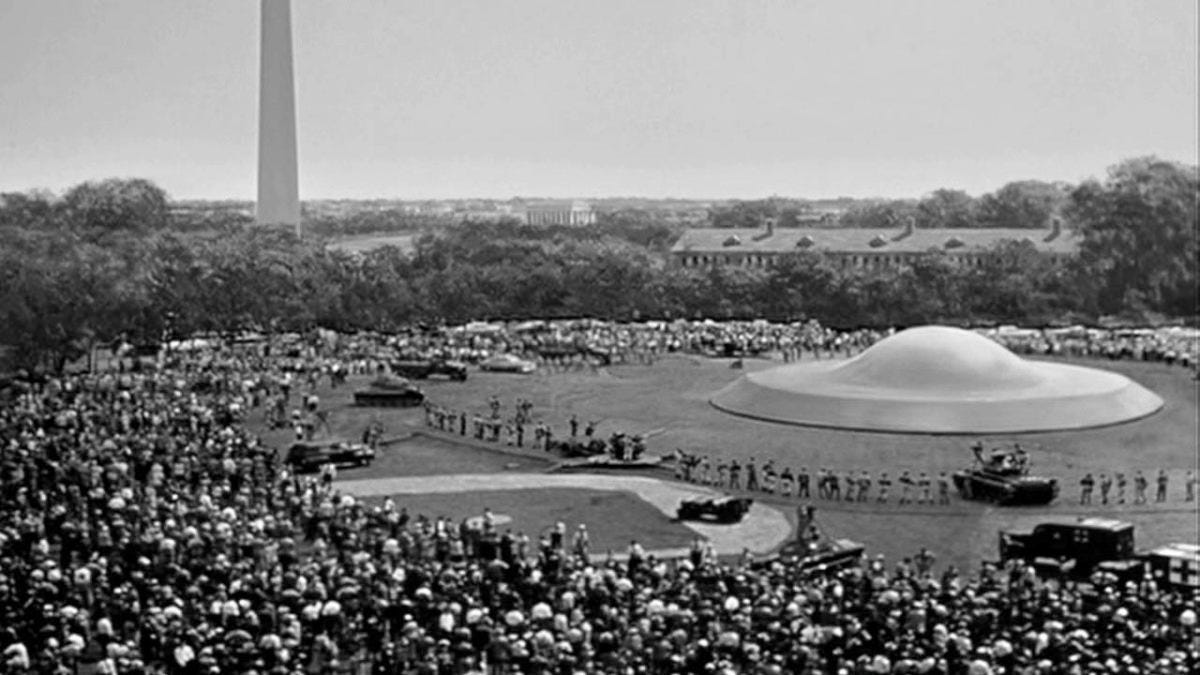
In 1951, Robert Wise’s The Day the Earth Stood Still imagined perhaps the most radical alien encounter in Hollywood history. Klaatu comes to Earth bearing a warning about humanity’s growing appetite for violence and atomic destruction. The army responds by shooting him immediately. Postwar America looks nervously into a mirror. What if humanity’s greatest danger is not the visitor from another world, but its own reflexive militarism? Unsurprisingly, the Pentagon declined cooperation with the production.
Nearly half a century later, Independence Day arrives with a very different vision of authority and finds itself at odds with the Pentagon as well. (I will happily admit this is one of my ultimate guilty pleasure films… when Will Smith punches the alien in the face and says “welcome to Earth” I get very excited.)
The premise is that the government lied. Area 51 is real. The conspiracy theorists were right all along. Yet when catastrophe arrives, Americans still turn toward military power for salvation. The film distrusts institutions while simultaneously believing they can save us. It is a peculiarly 1990s position: cynical but not yet disillusioned.
Then came Starship Troopers. Take a guess at whether that movie received any Pentagon assistance for taking a cosmic dump on the military industrial complex.
The film famously disguises itself as a patriotic war epic while quietly depicting a society that has transformed citizenship itself into a permanent military project. The bugs from space are secondary. The real horror is the civilization built to fight them. One of the enduring ironies of Starship Troopers is that many viewers initially consumed it as the very propaganda it was satirizing, while Paul Verhoeven asked a very uncomfortable question: what if the extraterrestrial threat is real and militarism is still the wrong answer?
And then came the War on Terror. Trust in institutions may have been eroding, but American popular culture increasingly sought reassurance in images of competence, coordination, and force. By the time Transformers arrives in 2007, the alien invasion movie is a different animal.
Gone is the nervous self-examination of The Day the Earth Stood Still. Gone is the institutional skepticism of Independence Day. Gone is the poisonous satire of Starship Troopers. The military is now heroic, technologically sophisticated, and morally uncomplicated. Alien invasion ceases to be a vehicle for questioning power and becomes a justification for it.
This shift was not only ideological but institutional. The Transformers franchise enjoyed extensive Pentagon cooperation, granting filmmakers access to military hardware, personnel, and locations in exchange for script review and consultation. The result is a vision of alien contact in which the military appears not as an imperfect human institution but as a near-mythological force of order. The aliens may be giant robots from another galaxy, but the real fantasy on display is bureaucratic efficiency.
If Transformers is a military recruitment poster disguised as a toy commercial, Battle: Los Angeles may be the purest expression of the Pentagon-approved alien invasion film. Here, there are no conspiracies, no institutional failures, no uncomfortable questions about power. There are simply Marines. Faced with an extraterrestrial threat, the solution is professionalism, discipline, sacrifice, and overwhelming force. Here, the aliens themselves are interchangeable with any enemy combatant. What matters is the opportunity they provide for military virtue to reveal itself. Compared with The Day the Earth Stood Still, where the soldier’s first instinct is to shoot a peaceful visitor, the ideological journey is remarkable. The alien has gone from moral teacher to target practice.
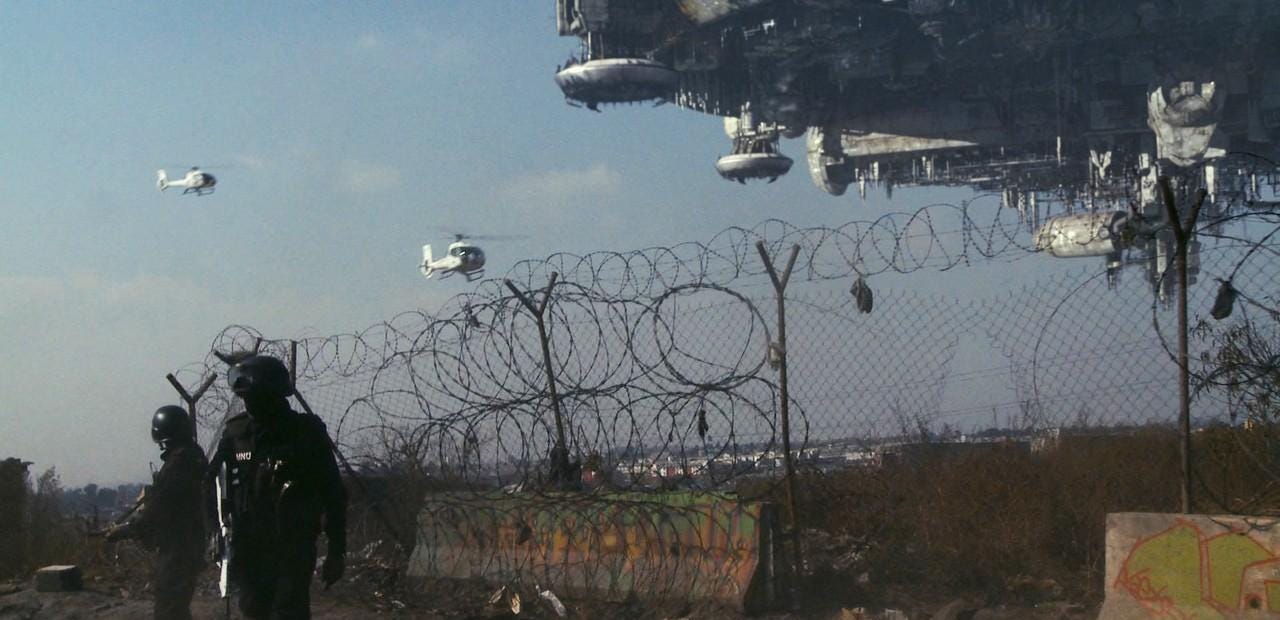
Yet perhaps the most important alien film for understanding our current moment is District 9. The extraterrestrials are no longer stand-ins for abstract fears of invasion, communism, technology, or the unknown. They aren’t even invaders. They are refugees. Undesirable outsiders. Bureaucratic problems.
Confined to sprawling camps, subjected to surveillance, harassment, and forced relocation, the aliens of District 9 are treated less like extraterrestrials than like a population nobody quite knows what to do with. Quickly the extraordinary becomes ordinary. The flying saucers hovering over Johannesburg fade into the background. What remains is paperwork, policing, segregation, and public resentment.
District 9 asks the audience to confront the comparison head-on. What does it mean to call a group of beings “alien”? What political work does that word perform? How easily does fear become bureaucracy, and bureaucracy become dehumanization?
Seen from today’s perspective, the film feels strangely prophetic. It may be the last major alien movie to use extraterrestrials as a critique of exclusion rather than a justification for it, which is precisely what makes the recent White House revival of “illegal alien” rhetoric so fascinating. Today the metaphor has folded in on itself. The aliens no longer arrive from another planet. They arrive from across the border.
Area 51 aesthetics decorate immigration enforcement. Flying saucers become deportation memes. The visual language once used to imagine contact with the unknown is repurposed to describe actual people.
For the past century, American alien films have served as a kind of national dream journal, recording the country’s hopes, fears, and shifting relationship with authority. The aliens themselves were never the point. The point was always what America saw when it looked at itself through them. So when the fellow human becomes the alien, what exactly is America seeing?
Let me know your thoughts in the comments! Which other alien movies come to mind?